Independent & educational platformNot a government body. No link or affiliation with any government organisation.Made for learning only. Test only systems you own or are authorised to test.Become a Partner or Sponsor →Full disclaimer
Independent & educational platformNot a government body. No link or affiliation with any government organisation.Made for learning only. Test only systems you own or are authorised to test.Become a Partner or Sponsor →Full disclaimer
General news
Stories are collected automatically from public feeds, attributed to their original publishers and linked. Editors can remove anything. Always read the original source.
Fraudsters are increasingly using AI to bypass stateless security checks. Cloudflare's new Account Abuse Protection dashboard uses stateful analysis and edge-generated Hashed User...
Quick Tunnels now support email authentication. Add --allowed-mail to one cloudflared command, and only the addresses or domains you list can reach your local app. No Cloudflare ac...
We’re building CryptoLabe, an internal AI-powered tool that discovers cryptography across our codebase, surfaces dependencies, and helps us progress toward a full post-quantum migr...
Twelve years after launching Universal SSL, Cloudflare is applying to become a certificate authority. By combining an established root, an ACME-first approach, and Merkle Tree Cert...
As post-quantum signatures threaten to inflate TLS handshakes and certificate transparency logs, Merkle Tree Certificates offer a path to compact, auditable authentication. Cloudfl...
Cloudflare has added visibility into post-quantum (PQ) encryption in TLS 1.3 directly into HTTP Analytics, Log Explorer, and Logpush. Learn how to make sure your domain is protecte...
Control characters like SOH, STX, EOT and ETX were never meant to run your code - but in the world of modern terminal emulators, they sometimes do. In this post, I'll dive into the...
Tired of repeating yourself? Automate your web security audit trail. In this post I'll introduce a new Burp AI extension that takes the boring bits out of your pen test. Web securi...
Introduction In this post, we’ll show precisely how to chain round-trip attacks and namespace confusion to achieve unauthenticated admin access on GitLab Enterprise by exploiting t...
Have you ever wondered how many vulnerabilities you've missed by a hair's breadth, due to a single flawed choice? We've just released Shadow Repeater, which enhances your manual te...
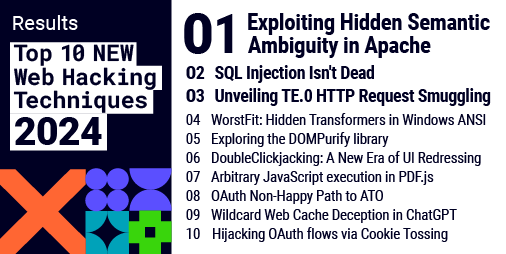
Welcome to the Top 10 Web Hacking Techniques of 2024, the 18th edition of our annual community-powered effort to identify the most innovative must-read web security research publis...
Unicode codepoint truncation - also called a Unicode overflow attack - happens when a server tries to store a Unicode character in a single byte. Because the maximum value of a byt...